
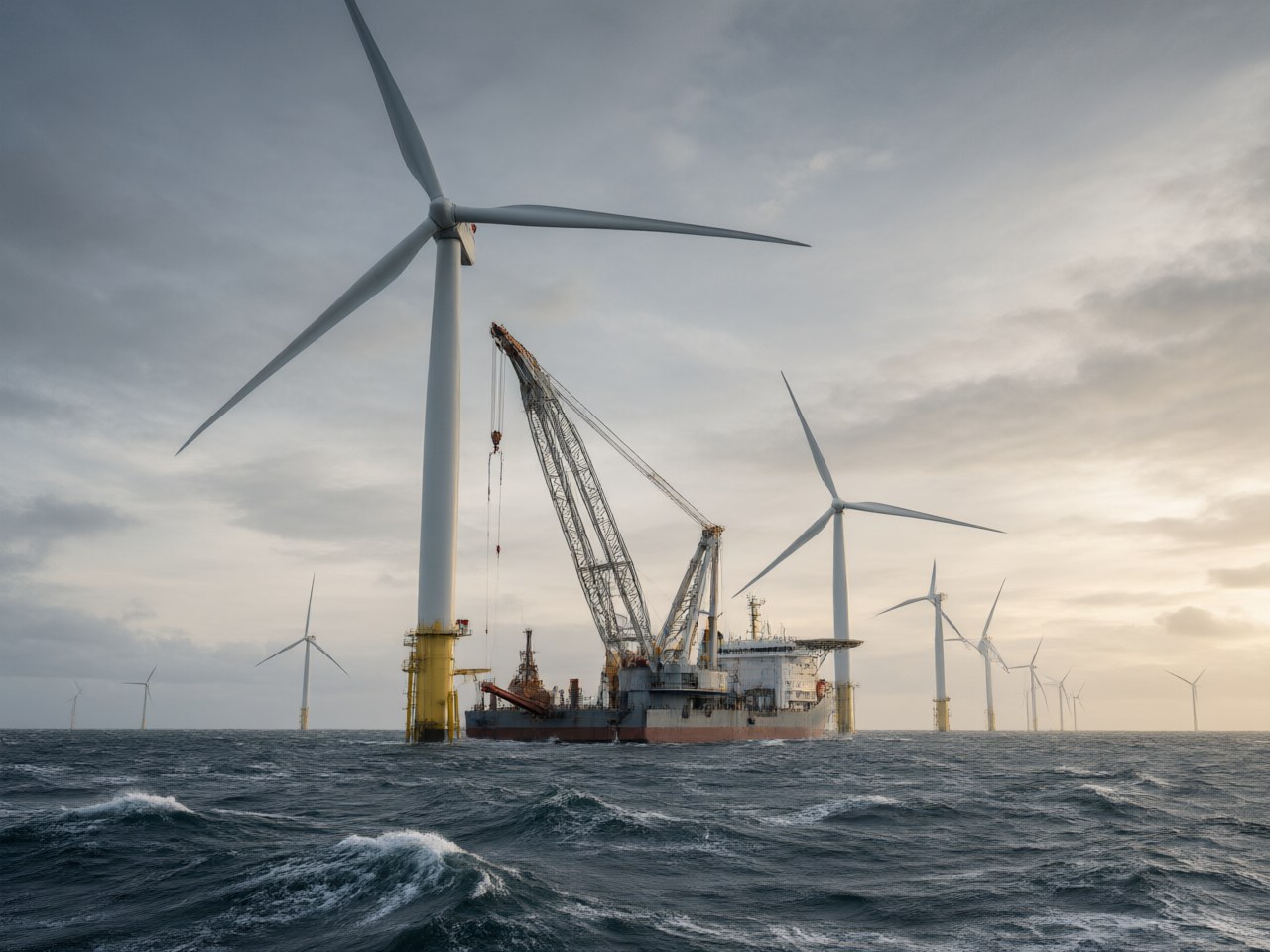
The European Commission has officially approved a €2.04 billion national support scheme for Belgium to fund the construction and operation of the first offshore wind farm in the Princess Elisabeth Zone (PEZ) in the North Sea. While the 735 MW project secures crucial funding…
This article is reposted from Juncai Magnetic Applications, with all rights reserved by the original author; the original link is available in the "Sources" section at the end.
On Tuesday, November 10, the European Commission officially announced the approval of a €2.04 billion national support scheme for Belgium. This funding is dedicated to supporting the construction and operation of the first offshore wind farm in the Princess Elisabeth Zone (PEZ) in the North Sea.
With a maximum installed capacity of 735 megawatts (MW) and an estimated annual power generation of up to 2.6 terawatt-hours (TWh), this wind farm has now secured the financial backing necessary for its realization.
However, for readers following the overseas expansion of China's wind power industry, behind this seemingly routine approval of state aid lies a set of more intriguing rules—one that effectively bars the world's most cost-effective wind turbine suppliers from the bidding process.
A "Lifeline" Subsidy: From €682 Million to €2.04 Billion
This aid did not emerge out of nowhere. In her statement, European Commission Vice President Teresa Ribera emphasized, "Energy that we produce ourselves is energy that we do not have to import," noting that the project will simultaneously enhance Europe's energy independence and decarbonization process.
Its predecessor can be traced back to 2024, when the EU had already approved €682 million in state aid under the "Temporary Crisis Framework" linked to the Russia-Ukraine conflict. However, these funds had to be materialized before the deadline of December 31, 2025.
Due to the sharp increase in grid infrastructure costs, the Belgian government was forced to suspend the originally planned PEZ 1 bidding, and the aid therefore remained unfulfilled. The newly approved €2.04 billion scheme is a continuation and expansion of the original aid against the backdrop of the bidding restart.
In terms of the support mechanism, the project adopts a two-way Contract for Difference (CfD): the government will subsidize producers when the market price falls below the agreed level, and conversely, it will claw back excess revenues when the market price is higher.
A notable technical detail is that the subsidy will be calculated based on the theoretical installed capacity of the wind farm rather than the actual grid-connected electricity volume. The purpose is to avoid indirectly subsidizing production during periods of negative electricity prices.
The Real Focus: A Set of Supply Chain Clauses Restricting Chinese Content
If one only looks at the subsidy amount, this is just an ordinary piece of European energy news. What truly attracts the attention of the Chinese industry is the supply chain restriction clauses that took effect alongside the bidding framework.
According to the revised bidding framework approved by the Belgian Federal Government in July this year and aligned with the EU's Net-Zero Industry Act (NZIA), this project has set layered caps on "Chinese content":
- Turbine Origin: At least 75% of the wind turbines in the project must not be manufactured or assembled in China;
- Key Components: For the aforementioned turbines, the number of key components sourced from China or assembled in China for a single turbine must not exceed four, and the drivetrain must be entirely overseas;
- Permanent Magnets: The proportion of permanent magnets used in the wind turbines sourced from China must not exceed 85%.
It is worth noting the weight of this last clause.
According to the European Commission's own assessment, the European wind turbine industry's reliance on Chinese permanent magnets is as high as 93%. In other words, even though the rules leave a "15%" opening, it is nearly impossible to piece together a completely China-free turbine in the short term within industrial reality. Rather than a "ban," it is more like using a posture that still leaves room to test whether the entire supply chain can truly pivot.
"Demanding the Lowest Price While Driving Away the Cheapest Vendors"
The original intention behind the design of these rules is full of tension. To get the project done, the new Belgian regulations have extended the maximum construction period of the wind farm from 4 years to 5 years, eliminated the execution price cap, and selected developers using a single two-way CfD based on "the lowest execution price wins."
The problem lies precisely here: calling for the lowest price on one hand, while barring the world's most cost-competitive suppliers on the other. Data best illustrates the weight of this—China's newly installed wind turbine capacity globally is projected to be around 140 GW in 2025, and approximately 76% of global wind turbine manufacturing capacity is concentrated in China. Actively removing such a price anchor means that the electricity price ultimately paid for this 700 MW-level wind farm will likely be significantly higher than in a scenario where Chinese players are welcome to participate.
Not Just Belgium: The "Red Line" for Chinese Wind Turbines in Europe
Belgium's choice is not an isolated case, but a slice of the collective pressure faced by Chinese wind power in Europe over the past two years.
According to calculations by British media, excluding Chinese wind turbines will slow down the pace of reducing the local levelized cost of wind power. The premium for political decisions will ultimately be repaid by ordinary households and businesses through higher electricity bills. Belgium's recent move is seen by observers as a replication of the same script—"resilience" should have pointed towards supply chain diversification, but it has been executed as disguised exclusion.
The Signal Significance of a "Testing Ground"
The total planned installed capacity of the Princess Elisabeth Zone reaches 3.5 GW, making it the most weighty piece of the puzzle among Europe's core offshore wind zones. Belgium is essentially using Europe's most valuable and highest-paying offshore wind market as a testing ground for supply chain rules.
The EU has written the rules into law, and Belgium is the first to transplant them into bidding documents. For China's wind power industry, which is accelerating its overseas expansion, this €2.04 billion subsidy and the set of restriction numbers—"75%, 4, 85%"—together constitute a new reality that must be seriously confronted: in the European market, whether or not one wins a bid is increasingly dependent on factors other than price itself.
Sources
- news.goalfore.cn › web (2026-11-12)
- Original link: European Commission Approves €2.04 Billion Offshore Wind Support Scheme for Belgium
- https://news.goalfore.cn/latest/detail/107487.html