
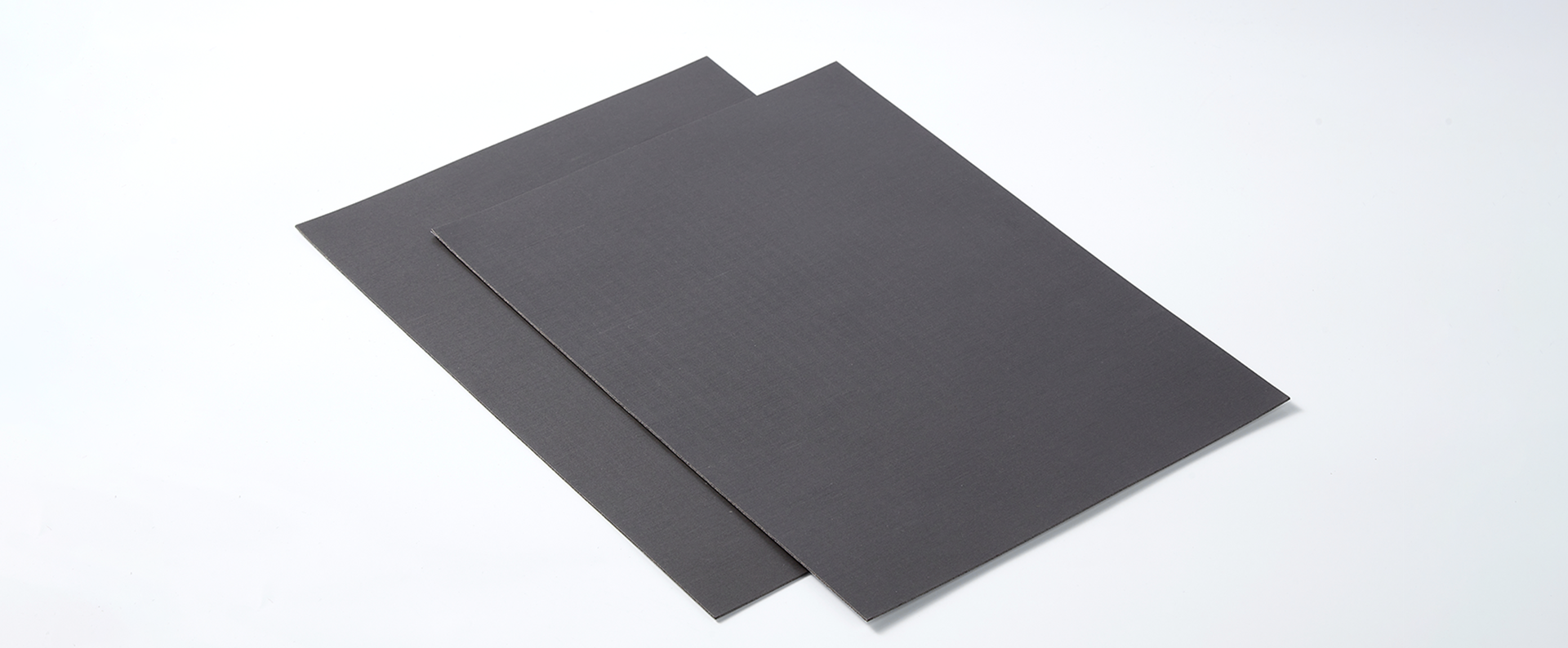
EMI Absorbing Material
EMI吸波材料
EMI absorbing materials are engineered composites — typically a polymer matrix loaded with soft-magnetic powder (ferrite / flaky metal / carbonyl-iron) — designed to absorb and attenuate electromagnetic waves rather than reflect them. Incoming RF energy is converted into negligible heat inside the lossy filler, suppressing reflection, cavity resonance, and inter-device electromagnetic interference (EMI).
AIC Engineering's WAM series covers permeability from 20 to 220 (measured at 1 MHz), thickness from 0.05 to 1.0 mm, and usable bandwidth up to 10 GHz. Basic, flame-retardant (FR), high-permeability, ultra-high-permeability, and low-loss variants address RFID / NFC tuning, broadband EMI suppression, and shielding screens respectively.
Supplied as roll or sheet stock, WAM materials can be die-cut, laminated, or directly applied to PCB ground planes, cable assemblies, antenna backings, and enclosure interiors. Operating temperature ranges from −40 °C up to 120 °C on FR / high-μ grades, covering automotive, 5G, and consumer electronics environments.
Key Features
μ' from 20 to 220
Eight permeability tiers — match the absorber to the frequency band and cavity mode you need to suppress.
Up to 10 GHz Bandwidth
WAM2000S remains effective to 10 GHz; high-μ grades cover up to 6 GHz; WAM3000R tuned for 13.56 MHz NFC / RFID.
Flame-Retardant Grades
WAM FR series rated for −40 to 120 °C with flame-retardant polymer matrix for automotive and 5G applications.
Roll or Sheet Supply
Supplied as roll or sheet — die-cut, laminated, or directly applied to PCBs, cables, antennas, and enclosures.
Magnetic Grades
Typical values at room temperature, sourced from the AIC Wave-absorbing Material performance data sheet. Representative subset — full WAM series (WAM2000S / 5000S / FR5000 / FR9000 / FR15000 / 9000 / 11000 / 15000 / 18000 / 3000R / 22000) available on request. Permeability measured at 1 MHz.
| Grade | Permeability μ' (1 MHz) | Thickness (mm) | Frequency Range | Op. Temp. (°C) | Product Type |
|---|---|---|---|---|---|
| WAM2000S | 20 ± 5 | 0.2–1.0 | up to 10 GHz | -40 to 85 | Basic |
| WAM5000S | 45 ± 10 | 0.1–0.5 | up to 6 GHz | -40 to 85/120 | Standard |
| WAM FR5000 | 45 ± 10 | 0.1–0.5 | up to 6 GHz | -40 to 120 | Flame-retardant |
| WAM9000 | 90 ± 10 | 0.05–0.5 | up to 6 GHz | -40 to 120 | High-permeability |
| WAM15000 | 150 ± 15 | 0.05–0.5 | up to 6 GHz | -40 to 120 | High-permeability |
| WAM3000R | 30 ± 10 | 0.1–0.5 | 13.56 MHz | -40 to 120 | Low-loss (NFC/RFID) |
| WAM22000 | 220 ± 20 | 0.1–0.5 | 0.5 MHz to 2 GHz | -40 to 120 | Ultra-high-permeability |
Supply form: roll or sheet. Permeability values are typical at 1 MHz; actual performance depends on frequency, geometry, and ground-plane conditions. Application notes indicate typical use cases — final selection should be validated by EMC test.
Composite Manufacturing
Soft-magnetic powder dispersion in a polymer matrix, cast to thin flexible sheets, and slit / die-cut to application form.
- Soft-magnetic powder selection (ferrite / flaky / carbonyl-iron)
- Surface coupling treatment
- Mixing into polymer binder (PA / FR resin)
- Deaeration & viscosity control
- Slot-die / knife coating onto release liner
- Thickness control to ±10 % of target
- Drying / curing oven
- Roll winding
- Slitting to width or sheet cutting
- Die-cutting to customer shape
- Lamination with adhesive (optional)
- Batch permeability & thickness QC
Typical Applications
Need a Custom EMI Absorber?
Send your frequency band, target attenuation, available thickness, and operating temperature — our engineers will recommend the right WAM grade, supply form (roll / sheet / die-cut), and adhesive option for your application.
Discuss Custom RequirementsProduct Manual
EMI Absorbing Material Product Manualabsorbing-material.pdfDownload PDFFrequently Asked Questions
Answers to common questions about our magnets, customisation, ordering and shipping.
- What is an EMI absorbing material? +
- An EMI absorbing material is a magnetic-particle-loaded rubber or polymer sheet that absorbs electromagnetic waves over a target band, suppressing cavity resonance and high-frequency noise in electronic assemblies.
- Where are EMI absorbing materials used? +
- They are applied inside electronic enclosures, on chips, antennas, and cables in consumer electronics, automotive ECUs, 5G/wireless modules, and radar to reduce辐射 emissions and improve EMI compliance.
- How do I select an absorbing material? +
- Select by target frequency band, absorption bandwidth, thickness, operating temperature, and form factor (sheet/roll/die-cut). AIC matches the magnetic filler and thickness to your absorption-vs-frequency curve.