
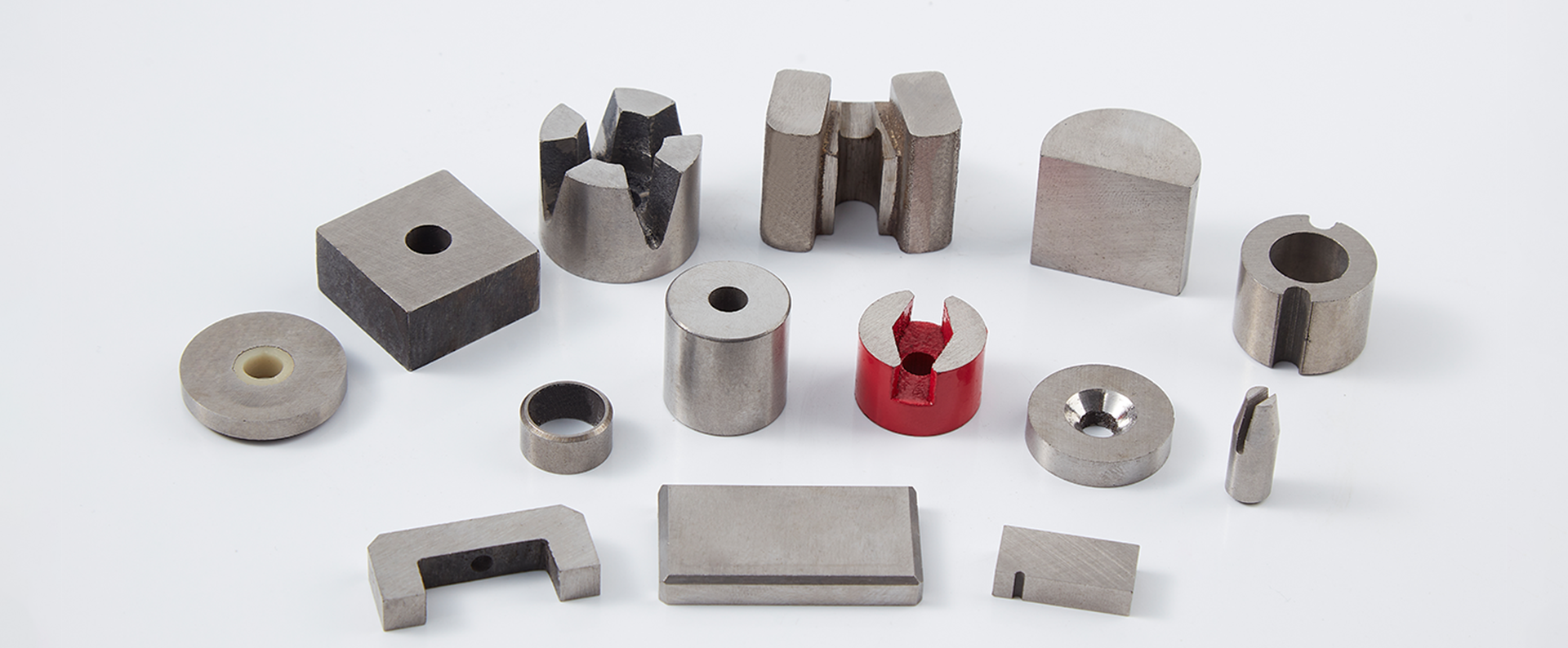
Aluminium-Nickel-Cobalt (AlNiCo) Magnet
铝镍钴(AlNiCo)磁体
AlNiCo is an alloy magnet made from aluminium, nickel, cobalt, iron, and small additions of copper and titanium. First developed in the 1930s, it remains the material of choice for applications that demand the highest temperature stability and the lowest reversible temperature coefficient of remanence of any commercial permanent magnet.
AIC Engineering supplies both sintered AlNiCo (FLN / FLNG / FLNGT series) and cast AlNiCo (LN / LNG / LNGT series). Cast grades offer the highest energy product (up to 12 MGOe for LNGT96); sintered grades deliver tighter dimensional tolerances and finer grain structure for small precision parts.
With Curie temperatures of 750–850 °C, maximum operating temperatures up to 550 °C, and α(Br) of just −0.02 %/°C, AlNiCo maintains stable magnetic output where NdFeB and ferrite would lose significant flux. It is also inherently corrosion-resistant and requires no coating for most applications.
Key Features
Best-in-Class Temp Stability
α(Br) just −0.02 %/°C — flux stays stable across wide temperature swings.
Up to 550 °C Operation
Highest operating temperature of any commercial permanent magnet material.
Inherent Corrosion Resistance
Metallic alloy — no coating needed for most indoor and outdoor applications.
Cast & Sintered Routes
Cast for maximum (BH)max up to 12 MGOe; sintered for tight-tolerance small parts.
Magnetic Grades
Typical values at room temperature, sourced from the AIC AlNiCo performance data sheet. Representative subset — the manual lists the full sintered FLN/FLNG/FLNGT and cast LN/LNG/LNGT series.
| Grade | MMPA Equivalent | Remanence Br (mT) | Coercivity Hcb (kA/m) | (BH)max (kJ/m³) | Max Op. Temp. (°C) |
|---|---|---|---|---|---|
| FLNG34 | S.AlNiCo5 | 1180 | 48 | 34 | 550 |
| FLNGT38 | S.AlNiCo8 | 800 | 120 | 38 | 550 |
| FLNGT42 | S.AlNiCo8 | 880 | 120 | 42 | 550 |
| LNG37 | AlNiCo5 | 1200 | 48 | 37 | 550 |
| LNG44 | — | 1250 | 52 | 44 | 550 |
| LNGT72 | AlNiCo9 | 900 | 110 | 72 | 550 |
| LNGT36J | AlNiCo8HC | 700 | 140 | 36 | 550 |
Curie temperature Tc: 750–850 °C. Reversible temperature coefficient of Br: −0.02 %/°C. Density: 6.9–7.3 g/cm³ (grade dependent).
Two Manufacturing Routes
Cast AlNiCo for maximum energy product; sintered AlNiCo for tight-tolerance small parts.
- Alloy melting in induction furnace
- Sand or precision investment casting
- Quench & controlled cooling
- Grinding of critical surfaces
- Magnetizing & inspection
- Atomised alloy powder
- Pressing in alignment field
- Sintering in protective atmosphere
- Heat treatment (HCD field cooling)
- Grinding & magnetizing
Typical Applications
Need a Custom AlNiCo Magnet?
Send your drawing or sample — our engineers will confirm grade (cast or sintered), dimensions, magnetization direction, and heat-treatment for your temperature and stability requirements.
Discuss Custom RequirementsProduct Manual
Aluminium-Nickel-Cobalt (AlNiCo) Magnet Product Manualalnico-magnet.pdfDownload PDFFrequently Asked Questions
Answers to common questions about our magnets, customisation, ordering and shipping.
- What are AlNiCo magnets used for? +
- AlNiCo magnets are used in high-temperature industrial applications, instruments, sensors, and lifting assemblies where stable performance up to 500 °C and low temperature coefficient matter.
- What is the maximum temperature of AlNiCo magnets? +
- AlNiCo operates up to about 500 °C with the lowest temperature coefficient among commercial magnets, making it suitable for high-temperature instruments and sensors.
- How does AlNiCo compare to NdFeB? +
- AlNiCo has much lower coercivity (easily demagnetised) and lower energy product than NdFeB, but far superior temperature stability and corrosion resistance for high-temperature use.