
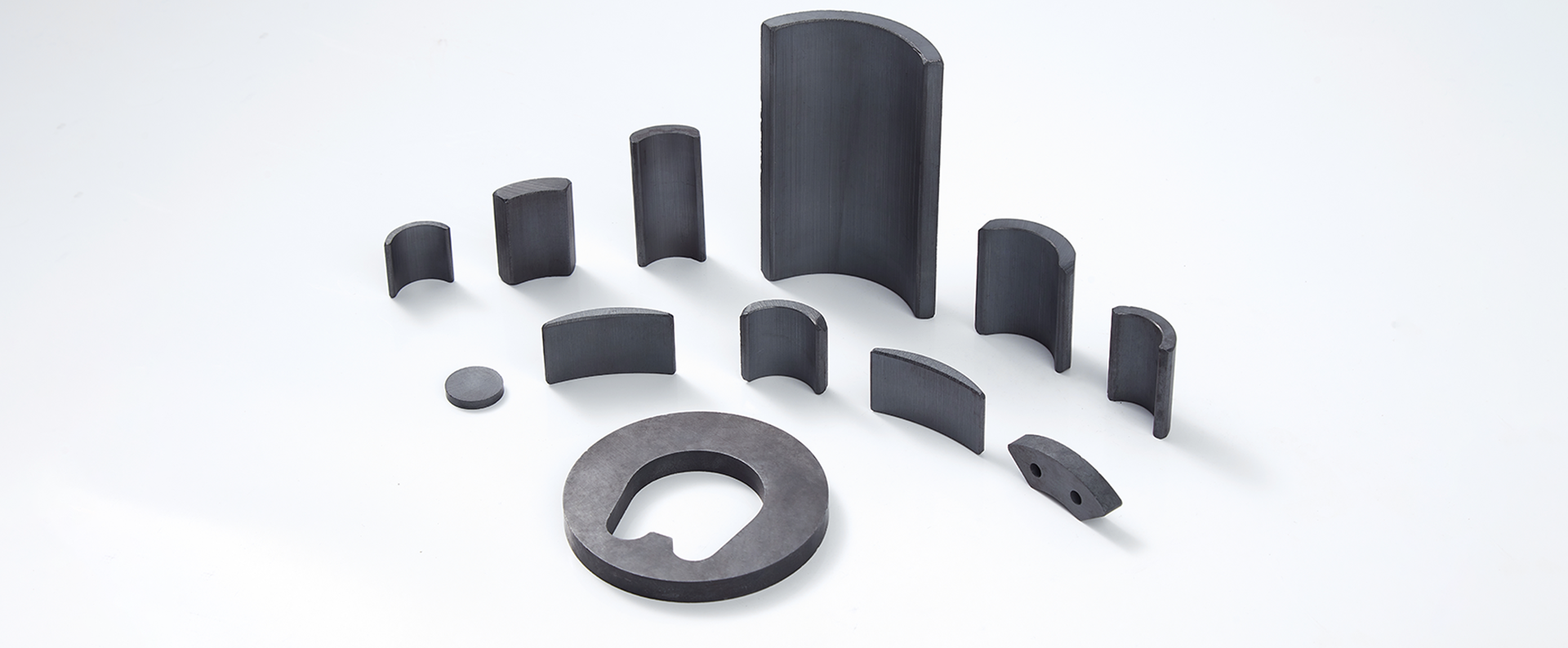
Ferrite Magnet
铁氧体磁体
Sintered ferrite (ceramic) magnets are strontium- or barium-ferrite compounds (SrO·6Fe₂O₃ / BaO·6Fe₂O₃) produced by powder metallurgy. They are the most economical permanent magnet material — lower magnetic performance than rare-earth grades, but with outstanding corrosion resistance, high chemical stability, and maximum operating temperatures up to 250 °C.
AIC Engineering supplies the full Y-series of isotropic and anisotropic sintered ferrite grades — from Y8T up to Y40 — covering (BH)max from 6.5 to 41.8 kJ/m³. Both dry-pressed (aniso/isotropic) and wet-pressed (anisotropic) routes are available, in disc, block, ring, and arc shapes for speakers, motors, and separators.
Because ferrite is a ceramic oxide, it is electrically insulating (no eddy currents), will not rust, and requires no coating. It is brittle but easily mass-produced at low cost, making it the default choice for high-volume applications where magnetic strength per unit cost matters more than peak flux density.
Key Features
Lowest Cost Per Magnet
Most economical permanent magnet material — ideal for high-volume cost-driven applications.
Excellent Corrosion Resistance
Ceramic oxide — will not rust, requires no coating, survives harsh chemical environments.
Up to 250 °C Operation
Stable performance at elevated temperatures; electrically insulating (no eddy-current losses).
Full Y-Series Coverage
Y8T to Y40 — isotropic and anisotropic grades for speakers, motors, and separators.
Magnetic Grades
Typical values at room temperature, sourced from the AIC Sintered Ferrite performance data sheet. Representative subset — full Y8T / Y22H / Y25 / Y26H-1 / Y26H-2 / Y27H / Y28 / Y28H-1 / Y28H-2 / Y30H-1 / Y30H-2 / Y32 / Y33 / Y33H / Y35 / Y40 range available on request.
| Grade | Remanence Br (mT) | Coercivity Hcb (kA/m) | Intrinsic Hcj (kA/m) | (BH)max (kJ/m³) | Max Op. Temp. (°C) |
|---|---|---|---|---|---|
| Y25 | 360–400 | 135–170 | 140–200 | 22.5–28.0 | < 250 |
| Y30H-1 | 380–400 | 230–275 | 235–290 | 27.0–32.5 | < 250 |
| Y32 | 400–420 | 160–190 | 165–195 | 30.0–33.5 | < 250 |
| Y33H | 410–430 | 250–270 | 250–275 | 31.5–35.0 | < 250 |
| Y35 | 430–450 | 215–239 | 217–241 | 33.1–38.2 | < 250 |
| Y40 | 440–460 | 330–354 | 340–360 | 37.6–41.8 | < 250 |
All grades: maximum operating temperature ≤ 250 °C. Density ≈ 4.8–5.0 g/cm³. Br reversible temperature coefficient ≈ −0.18 %/°C.
Ceramic Powder Metallurgy
Oxide raw materials → calcination → milling → pressing in magnetic field → sintering → grinding.
- SrCO₃ / BaCO₃ + Fe₂O₃ raw materials
- Calcination pre-firing (1200–1300 °C)
- Wet or dry ball milling to 1–2 μm
- Milling additive dosing
- Wet or dry pressing in alignment field
- Green-part drying (wet-pressed)
- Sintering (1200–1250 °C)
- Density & shrinkage control
- Diamond grinding to tolerance
- Visual & dimension inspection
- Pulse magnetizing
- Bulk packaging
Typical Applications
Need a Custom Ferrite Magnet?
Send your drawing or sample — our engineers will confirm grade, shape (disc / block / ring / arc), tolerance, and magnetization for your application. Volume pricing on request.
Discuss Custom RequirementsProduct Manual
Ferrite Magnet Product Manualferrite-magnet.pdfDownload PDFFrequently Asked Questions
Answers to common questions about our magnets, customisation, ordering and shipping.
- What are the advantages of ferrite (ceramic) magnets? +
- Ferrite magnets are low-cost, corrosion-resistant (no coating needed), and electrically insulating, making them ideal for high-volume applications where maximum strength is not required.
- What is the maximum operating temperature of ferrite magnets? +
- Ferrite magnets operate up to about 250 °C with excellent temperature stability and low reversible loss, suitable for motors and sensors in thermal environments.
- Do ferrite magnets need a coating? +
- No. Ferrite is chemically stable and corrosion-resistant, so no protective coating is required, unlike NdFeB.