
Heavy-Rare-Earth-Free NdFeB Magnet
无重稀土烧结钕铁硼(NdFeB)磁体
HRE-free alloy design and sintering for N/M/H/SH grades — material innovation that reduces raw-material cost volatility while maintaining full magnetic performance and reliable volume delivery.
AIC Engineering's heavy-rare-earth-free sintered NdFeB (green process route) optimises alloy composition and sintering microstructure with no dysprosium or terbium added during manufacturing. Covering N, M, H, and SH series, it delivers a cost-efficient permanent-magnet option for motors, consumer electronics, and industrial equipment.
For higher-coercivity SH/UH/EH requirements, grain-boundary diffusion (GBD, yellow route) or conventional heavy-rare-earth alloying (blue route) are also available — see the performance chart below. GBD achieves the same coercivity with 40–70% less heavy rare earth versus conventional bulk alloying.
Key Advantages
Optimised Cost Structure
Less reliance on dysprosium and terbium in the alloy recipe — raw-material price swings have less impact on unit cost, making long-term procurement more predictable.
Reliable Volume Delivery
A mature, production-ready process route aligned with mainstream capacity — from prototyping through to steady bulk supply.
Strong N–SH Performance
HRE-free alloy and microstructure control deliver high (BH)max and coercivity across N, M, H, and SH grades.
N–SH Grade Coverage
N50–N60, 48M–58M, 42H–54H, 30SH–52SH — mainstream motor, consumer, and industrial applications.
Three Process Routes — Performance Comparison
The chart maps intrinsic coercivity (Hcj) vs. maximum energy product BH(max) for each process route. This product is the green HRE-free route (N–SH); yellow and blue routes are available for higher-temperature grades.
Schematic illustration only — not an exact reproduction of measured coordinates or the original technical chart.
Grade Coverage
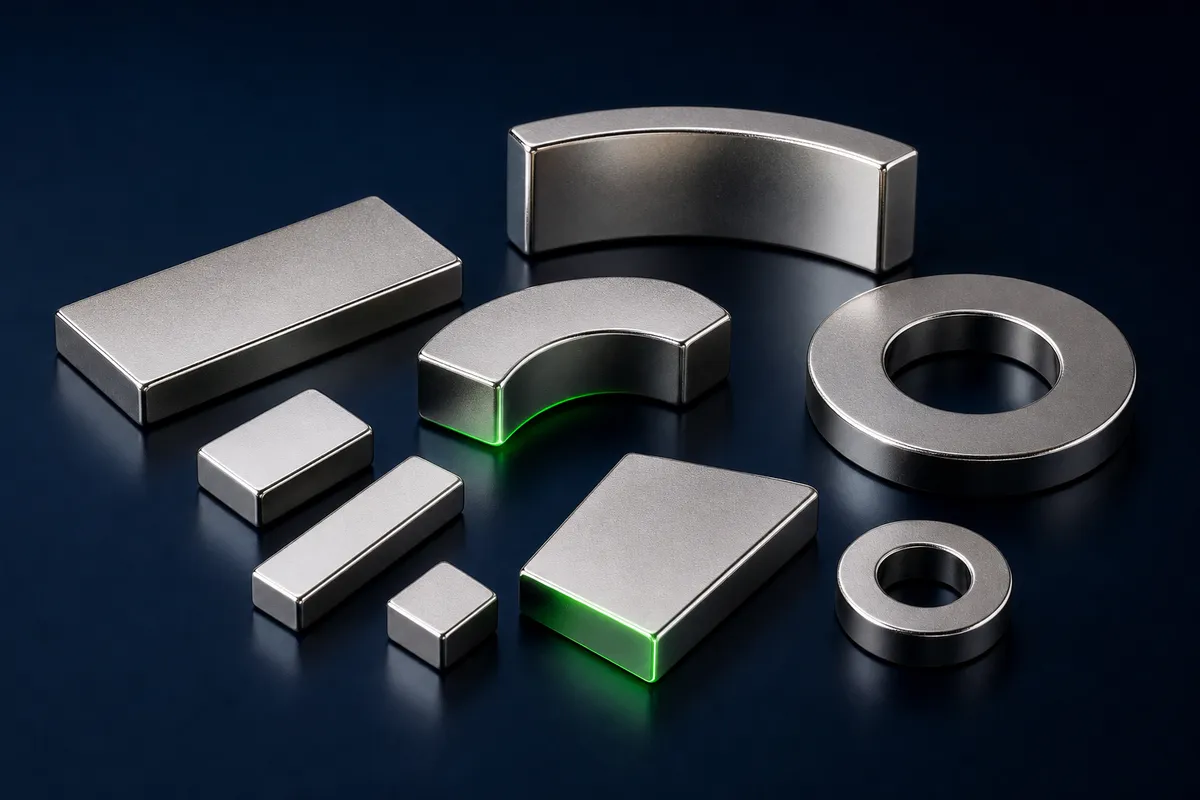
All grades are available in standard shapes (block, cylinder, ring, arc/tile, special-shaped).
Heavy-Rare-Earth-Free Process — No Dy/Tb (This Product)
N / M / H / SH series — no dysprosium or terbium in alloy composition or manufacturing
The HRE-free route uses optimised alloy design and sintering without adding dysprosium or terbium, covering N, M, H, and SH grades with balanced (BH)max, coercivity, and batch consistency.
Compared with conventional bulk alloying, it uses significantly less heavy rare earth while maintaining strong magnetic performance across mainstream grade bands — a practical balance of performance and cost.
Typical Applications
No dysprosium or terbium in alloy composition and manufacturing
HRE-Free Grade Coverage
| Series | Grades Covered | Min. Hcj |
|---|---|---|
| N | N50 / N52 / N54 / N56 / N58 / N60 | ≥ 12 kOe |
| M | 48M / 50M / 52M / 54M / 56M / 58M | ≥ 14 kOe |
| H | 42H / 45H / 48H / 50H / 52H / 54H | ≥ 17 kOe |
| SH | 30SH / 33SH / 35SH / 38SH / 40SH / 42SH / 45SH / 48SH / 50SH / 52SH | ≥ 20 kOe |
Grain-Boundary Diffusion (GBD) — High Coercivity, Low HRE
For SH / UH / EH grades requiring higher operating temperatures
Grain-boundary diffusion (GBD) introduces dysprosium or terbium at the magnet surface or near-surface; subsequent diffusion heat treatment distributes it along grain boundaries, sharply boosting coercivity and high-temperature stability without heavy overall alloy addition.
Compared with conventional bulk alloying, GBD achieves the same grade coercivity with 40–70% less total Dy/Tb — maintaining high performance while improving material cost efficiency.
Typical Applications
Less heavy rare earth at equivalent coercivity (vs. conventional process)
GBD Grade Coverage
| Series | Grades Covered | Min. Hcj |
|---|---|---|
| SH | 35SH–56SH (full) | ≥ 20 kOe |
| UH | 35UH–54UH (full) | ≥ 25 kOe |
| EH | 33EH–52EH (full) | ≥ 30 kOe |
| Series | Grades Covered | Min. Hcj |
|---|---|---|
| SH | 42SH–56SH | ≥ 20 kOe |
| UH | 38UH–48UH | ≥ 25 kOe |
| EH | 33EH–40EH | ≥ 30 kOe |
Typical Applications
Need HRE-Free NdFeB for Your Project?
Our engineering team can advise on grade selection, size feasibility, coating, and MOQ. Prototype quantities from 10 g — sample fee credited on bulk order.
Contact Engineering TeamFrequently Asked Questions
Answers to common questions about our magnets, customisation, ordering and shipping.
- What is a heavy-rare-earth-free NdFeB magnet? +
- Heavy-rare-earth-free (HRE-free) NdFeB reduces or eliminates dysprosium and terbium additions while maintaining coercivity through grain-boundary diffusion and process optimisation — lowering cost and supply risk.
- Why choose HRE-free NdFeB? +
- It lowers dependence on scarce heavy rare earths (Dy/Tb), reduces cost and supply-chain risk, and still meets the coercivity and temperature requirements of many EV and industrial motor applications.
- Does HRE-free NdFeB sacrifice temperature performance? +
- Modern HRE-free grades with grain-boundary diffusion achieve high coercivity comparable to Dy-added grades for many operating points; extreme high-temperature grades may still require HRE additions.