
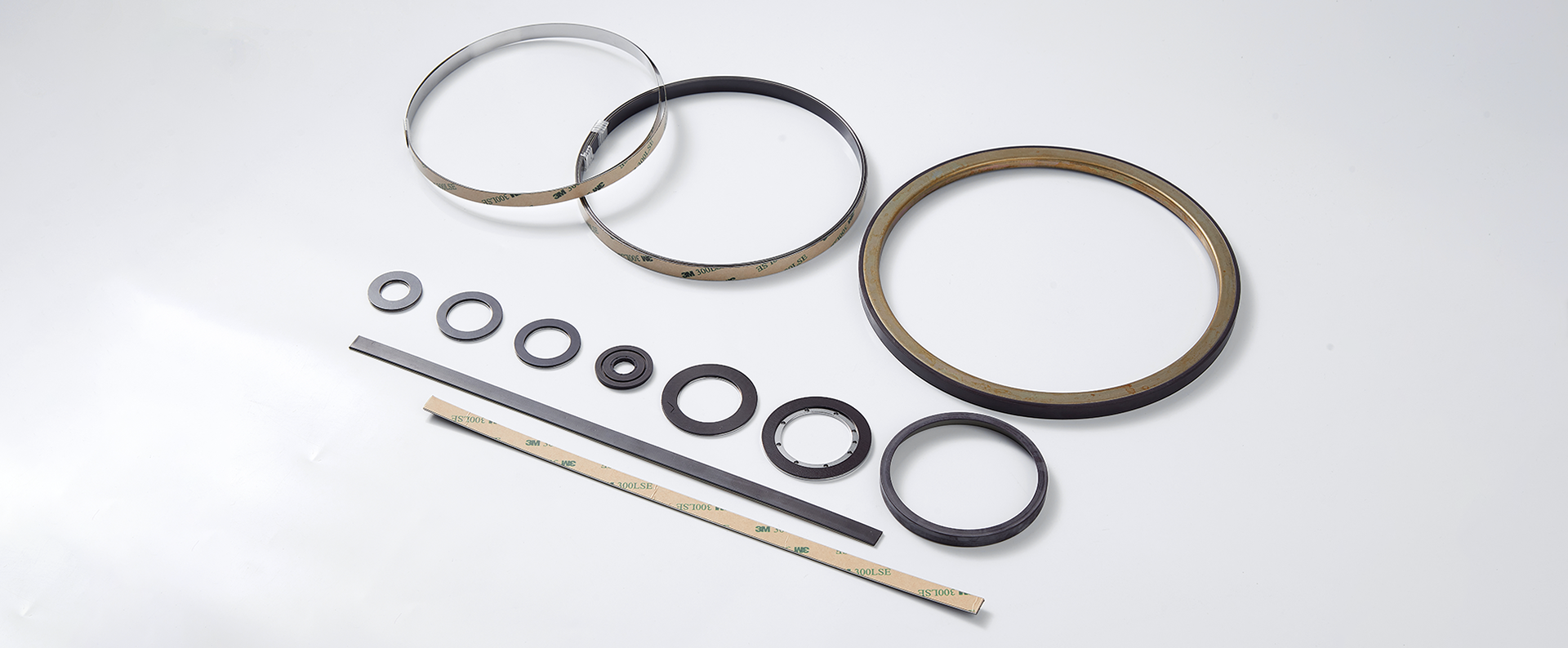
Linear Encoder Magnet
磁栅尺
A linear encoder (magnetic scale ruler) is a precision displacement measurement device that pairs a magnetically encoded strip with a Hall/MR sensor head. As the head travels along the strip, it reads the pole-pitch field pattern and outputs a position signal with micrometre-class resolution — immune to oil, dust, and chips that defeat optical encoders.
AIC Engineering's JC-F series supplies magnetic scale strips in 1 mm, 2 mm, and 5 mm pole pitches, 50 m roll length, 10 mm width, and 1.43 mm scale thickness. Accuracy is ≤ 0.02 mm/m across a −20 to 80 °C operating range — suited to machine tools, automation lines, robotics, aerospace, rail, and woodworking / textile / paper machinery.
Because the reading is magnetic, the scale survives harsh environments where optical gratings fog or contaminate. Installation and maintenance are simple, the strip can be cut to length on site, and the non-contact reading head has no wear — together lowering total cost of ownership versus optical or inductive alternatives.
Key Features
Micrometre Resolution
Pole-pitch magnetic reading delivers µm-class resolution — precision measurement for machine tools and automation.
Immune to Oil, Dust, Chips
Magnetic reading defeats the contamination that blinds optical encoders — reliable in harsh machine environments.
≤ 0.02 mm/m Accuracy
JC-F series accuracy ≤ 0.02 mm/m across −20 to 80 °C — stable in real workshop conditions.
50 m Roll, Cut On Site
Supplied as 50 m rolls — cut to required length during installation; simple mounting, low maintenance.
Scale Models
Typical values, sourced from the AIC Magnetic Grid Ruler performance data sheet. Representative subset — other pole pitches can be customised on request.
| Model | Pole Pitch (mm) | Roll Length (M) | Width (mm) | Scale Thickness (mm) | Accuracy (mm/m) | Op. Temp. (°C) |
|---|---|---|---|---|---|---|
| JC-F-01 | 1 | 50 | 10 | 1.43 | ≤ 0.02 | -20 to 80 |
| JC-F-02 | 2 | 50 | 10 | 1.43 | ≤ 0.02 | -20 to 80 |
| JC-F-05 | 5 | 50 | 10 | 1.43 | ≤ 0.02 | -20 to 80 |
Other pole pitches can be customised. Cover strip optional for environmental protection. Sensor head and signal-conditioning electronics selected per host controller interface.
Scale Manufacturing
Magnetic strip with encoded pole pattern, bonded to a flexible carrier, slit to width, and supplied as roll stock.
- Magnetic strip material selection
- Multi-pole magnetising to pitch (1 / 2 / 5 mm)
- Pole-pattern accuracy verification
- Field-strength uniformity check
- Bond magnetic strip to flexible carrier
- Optional protective cover-strip lamination
- Slit to 10 mm width
- Length verification per 50 m roll
- Pitch-accuracy sampling along roll
- Magnetic field profile measurement
- Roll winding onto spool
- Installation instructions included
Typical Applications
Need a Custom Linear Encoder Scale?
Send your required pole pitch, length, mounting surface, and sensor-head interface — our engineers will confirm the right JC-F model, cover strip, and signal conditioning for your application.
Discuss Custom RequirementsProduct Manual
Linear Encoder Product Manuallinear-encoder.pdfDownload PDFFrequently Asked Questions
Answers to common questions about our magnets, customisation, ordering and shipping.
- What is a magnetic linear encoder? +
- A magnetic linear encoder reads a multi-pole magnetic scale to determine linear position, offering robust, non-contact sensing resistant to dust, oil, and shock—unlike optical encoders.
- What resolution can a magnetic linear encoder achieve? +
- Resolution depends on pole pitch and interpolation; AIC supplies matched magnetic scales and sensor magnets enabling micron-level resolution over long travel.
- Why choose a magnetic encoder over an optical encoder? +
- Magnetic encoders tolerate dust, oil, moisture, and vibration that would foul optical scales, making them preferable for machine tools, automation, and harsh industrial environments.