
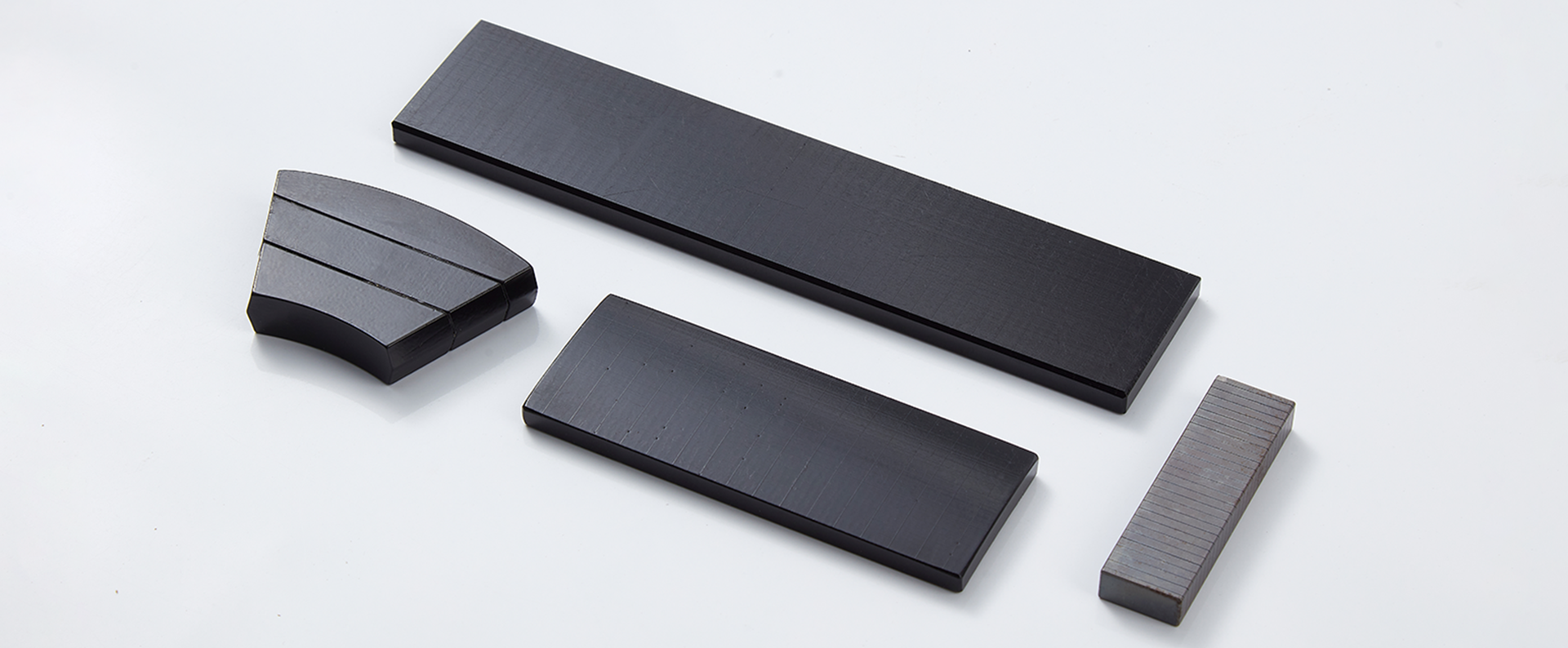
NdFeB Lamination Magnet
钕铁硼叠片(NdFeB)磁体
NdFeB lamination magnets are layered structures built from precision-cut sintered NdFeB sheets, bonded or mechanically stacked into a single composite magnetic assembly. Each layer is electrically insulated from its neighbours, so high-frequency flux reversals produce only small per-layer eddy currents instead of one large bulk eddy current — dramatically cutting eddy-current losses in high-speed motors and generators.
AIC Engineering produces laminated NdFeB assemblies in arc, block, ring, and custom shapes, with inter-layer adhesive bonding, mechanical keying, or over-moulded construction. The layered design also enables skew stacking to reduce cogging torque, segmented arcs to approximate sinusoidal flux distribution, and graded magnet grades stacked along the rotor axis to optimise field profile.
Lamination magnets are the answer when motor speed, switching frequency, or pulse duty pushes eddy-current losses beyond what a solid NdFeB magnet can tolerate — typically in EV traction motors, drone and eVTOL propulsion, high-RPM spindles, and aerospace generators where efficiency and thermal stability are critical.
Key Features
Reduced Eddy-Current Loss
Electrically insulated layers confine eddy currents to each sheet — dramatic loss reduction at high frequency and high RPM.
Skew & Segmented Stacking
Skew stacking cuts cogging torque; segmented arcs approximate sinusoidal flux for smoother motor operation.
Graded Magnet Profiles
Different NdFeB grades stacked along the axis to tailor flux profile and temperature behaviour per design.
High-Speed Motor Ready
Designed for EV traction, drones, eVTOL, spindles, and aerospace generators where solid NdFeB overheats.
Design & Construction Options
Configurable per application — send your motor topology and operating point and our engineers will confirm the right combination.
| Construction Option | Description | Typical Benefit |
|---|---|---|
| Adhesive-Bonded Stack | Precision-cut NdFeB sheets bonded with thin insulating adhesive. | General-purpose eddy-current reduction; tight tolerances. |
| Mechanically Keyed Stack | Interlocking sheet geometry for mechanical alignment. | High structural integrity under high centripetal load. |
| Over-Moulded Lamination | Stacked sheets encapsulated in polymer or metal sleeve. | Environmental protection + rotor-ready assembly. |
| Skew-Stacked Arcs | Arc segments angularly offset along the axis. | Reduced cogging torque and acoustic noise. |
| Segmented Sinusoidal Arc | Multiple arcs per pole approximating sinusoidal flux. | Smoother back-EMF, lower harmonic distortion. |
| Graded Multi-Grade Stack | Different NdFeB grades stacked along the axis. | Tailored flux profile and temperature coefficient. |
Manufacturing Routes
Pressing, injection moulding, extrusion, and winding techniques are used to ensure precise lamination forming and meet complex design requirements.
- Sintered NdFeB block or arc base material
- Wire-EDM or grinding to thin sheet
- Surface insulation coating (epoxy / phosphate)
- Dimensional inspection of each sheet
- Adhesive bonding or mechanical keying
- Skew or graded stacking per design
- Cure / press consolidation
- Encapsulation or over-moulding (optional)
- Final grinding to rotor bore / outer arc
- Pulse magnetizing to pole pattern
- 100% flux & insulation-resistance inspection
- Rotor-ready packaging
Typical Applications
Need a Custom NdFeB Lamination Magnet?
Send your motor topology, operating point, and target losses — our engineers will design the lamination layout, stacking pattern, and base NdFeB grade for your application.
Discuss Custom RequirementsFrequently Asked Questions
Answers to common questions about our magnets, customisation, ordering and shipping.
- What is an NdFeB lamination magnet? +
- NdFeB lamination magnets are segmented and insulated magnet blocks (or laminated stacks) used in high-speed motor rotors to reduce eddy-current losses and heating at high frequency.
- Why use laminated NdFeB in high-speed motors? +
- Segmenting and insulating the magnets breaks eddy-current paths, dramatically reducing eddy losses and rotor heating at high RPM and high-frequency PWM — improving motor efficiency and preventing demagnetisation from local overheating.
- How thin can NdFeB laminations be made? +
- Lamination segments can be produced down to sub-millimetre thickness with insulation coating between segments, assembled and magnetised to the rotor pole pattern.