
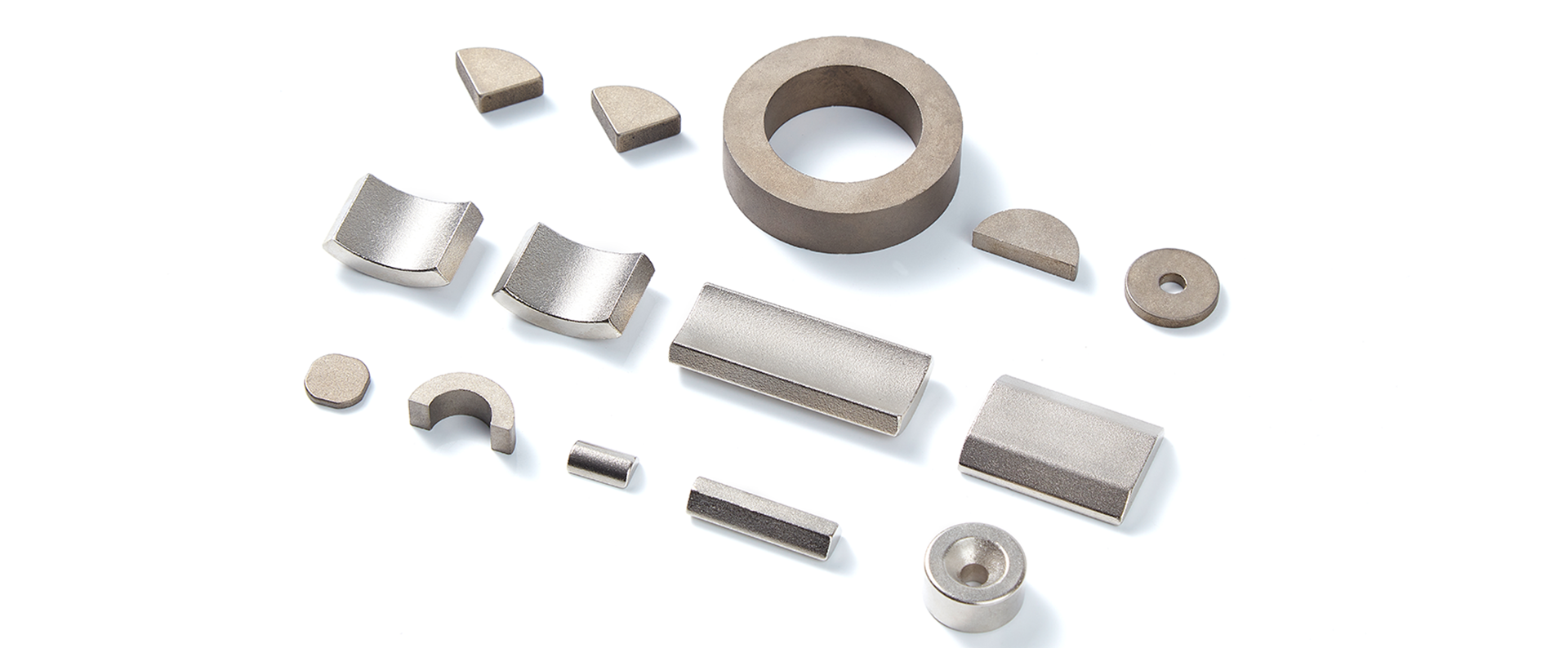
Sintered Samarium Cobalt (SmCo) Magnet
烧结钐钴(SmCo)磁体
Samarium-cobalt (SmCo) is the second-generation rare-earth permanent magnet. While its maximum energy product is lower than NdFeB, SmCo excels where NdFeB cannot operate — high temperatures up to 350 °C (550 °C for XGS-HT grades), corrosive or oxidising environments, and applications demanding the lowest reversible temperature coefficient of remanence.
AIC Engineering supplies the full SmCo range per GB/T 17951-2022: Sm₂Co₁₇ (SMG / HTS / LTS series), SmCo₅ (SM series), and ultra-high-temperature Sm₂Co₁₇ (XGS-HT up to 550 °C). Hcj above 1990 kA/m is standard across SMG-H grades for stable performance under demagnetising fields and elevated temperatures.
Because SmCo is intrinsically oxidation- and corrosion-resistant, no coating is required for most applications — a critical advantage in aerospace, defense, oil & gas, and medical equipment where coating failure would compromise reliability.
Key Features
Up to 350 °C Standard, 550 °C HT
XGS-HT grades operate at 550 °C — far beyond NdFeB or ferrite limits.
Low Temperature Coefficient
α(Br) as low as 0.005 %/°C for LTS low-temp-coefficient series — flux stable across wide ranges.
Intrinsic Corrosion Resistance
Metallic rare-earth alloy — no coating required, even in oxidising and humid environments.
High Hcj, Anti-Demagnetization
Hcj ≥ 1990 kA/m on SMG-H grades — stable under strong demagnetising fields and reverse pulses.
Magnetic Grades
Typical values at room temperature, sourced from the AIC Sintered SmCo performance data sheet (per GB/T 17951-2022). Representative subset — full Sm₂Co₁₇ (SMG / HTS / LTS), SmCo₅ (SM), and XGS-HT series available on request.
| Grade | Series | Remanence Br (mT) | Coercivity Hcb (kA/m) | Intrinsic Hcj (kA/m) | (BH)max (kJ/m³) | Max Op. Temp. (°C) |
|---|---|---|---|---|---|---|
| SMG-24H | Sm₂Co₁₇ | 960–1030 | ≥ 724 | ≥ 1990 | 175–199 | 350 |
| SMG-28H | Sm₂Co₁₇ | 1040–1090 | ≥ 749 | ≥ 1990 | 207–231 | 350 |
| SMG-32H | Sm₂Co₁₇ | 1120–1150 | ≥ 812 | ≥ 1990 | 239–255 | 350 |
| SM-16 | SmCo₅ | 790–860 | ≥ 605 | ≥ 1592 | 119–143 | 250 |
| XGS24HT | Sm₂Co₁₇ HT | 950–1000 | 685–772 | ≥ 1592 | 175–191 | 550 |
| LTS20 | Sm₂Co₁₇ LTS | 870–930 | ≥ 653 | ≥ 1592 | 151–175 | 300 |
Reversible temperature coefficient |α(Br)|: 0.03–0.05 %/°C (standard), 0.005–0.02 %/°C (LTS low-coefficient series). |β(Hcj)|: 0.2–0.3 %/°C. Density: 8.3–8.5 g/cm³.
Powder-Metallurgy Process
From alloy design to magnetized, inspected parts — every step controlled in-house for batch consistency.
- Sm / Co / Fe / Cu / Zr alloy design
- Vacuum induction melting & casting
- Hydrogen decrepitation (HD)
- Jet milling to 3–5 μm powder
- Die or rubber-mould pressing in alignment field
- Vacuum sintering (1150–1250 °C)
- Solution treatment & ageing
- Blank density inspection
- EDM / grinding to ±0.05 mm tolerance
- Surface inspection (no coating needed)
- Pulse magnetizing to design direction
- 100% flux measurement & packaging
Typical Applications
Need a Custom SmCo Magnet?
Send your drawing or sample — our engineers will confirm grade (Sm₂Co₁₇ / SmCo₅ / XGS-HT / LTS), dimensions, magnetization, and temperature-stability target for your application.
Discuss Custom RequirementsProduct Manual
Sintered Samarium Cobalt (SmCo) Magnet Product Manualsamarium-cobalt-magnet.pdfDownload PDFFrequently Asked Questions
Answers to common questions about our magnets, customisation, ordering and shipping.
- What is the maximum temperature for SmCo magnets? +
- AIC high-temperature SmCo grades are stable up to 550 °C, far exceeding NdFeB, with low temperature coefficient of remanence — ideal for high-temperature industrial and aerospace applications.
- Is SmCo corrosion resistant? +
- Yes. SmCo has excellent corrosion and oxidation resistance and generally requires no coating, even in harsh environments where NdFeB would need protection.
- SmCo vs NdFeB — when to choose SmCo? +
- Choose SmCo when high-temperature stability (>150 °C), low temperature drift, or corrosion resistance matters more than raw strength. Choose NdFeB when maximum energy product and cost dominate.